Note: This is part 1 of 2. It introduces a drama project that attempts to engage students more deeply with reading.
Here is my big idea question for 2026: Can I use art to level up my students’ engagement with language? My instinct says yes, but my coursebook doesn’t offer a lot of options. So I struck out on my own to find out. In this project, I include historical fiction and art as content and a process drama performance as a product. As is often the case, I learned things I didn’t expect.
Most of my high beginner students come to our evening class at the end of a long workday. I make coffee, and for the next three and a half hours, we work on language tasks that will accommodate different abilities and goals. Considering they are generally exhausted, stressed, and sometimes nervous about returning to school as adults, I try to set a pace that feels comfortable while ensuring progress. I also try to go beyond the more technical aspects of language so that they develop academically, work toward professional goals and have meaningful social experiences in English.
In our class, reading comes after a mentally draining grammar and pronunciation workout that focuses on language elements. Students get a break, and then we scale out to engage with ideas. On most nights, we read a chapter in a graded novel. The reading, which is sometimes done aloud, is intended to afford learners a comfortable receptive experience that leads to a productive discussion. Students seem to relate to characters and enjoy following their journeys. Also, the character conflicts can be a jumping off point for light academic content and skills. For example, when we read Warehouse 54 (GEMMA), which is about a family coping with a manufacturing accident, we also read adapted articles about workplace safety.
The Premise
Last night, I was slightly terrified about trying my new lesson plan, which included both challenging texts and a process drama component in which students would become characters from history. I was particularly uncertain because my class never has the same group of students at once. We were also hosting guest students who were coming in at a slightly higher level, so I had prepared my students with some vocabulary work and a reading ahead of time.
Even with some advanced preparation, I was asking a lot with this project, since the texts were well above the readings in our coursebook. However, I was motivated by my participation in a reading across the curriculum initiative. Our charge was not just to read articles and talk about reading. It was to turn theory into practice. If my lesson went well, students would not only practice speaking and pick up some vocabulary. They would also take a deep dive into understanding and working with the content – something that has become a concern across our institution and in education generally.
I put my faith in historical fiction. I hoped that a personal connection to characters in true stories would make them indignant, curious, and analytical. They would repeatedly go back into the readings, discuss different perspectives, compare and connect information across texts, relate it to their own lives, and draw conclusions about the world.
This is what process drama aims to do.
Originally developed through drama‑in‑education work in the 1960s and later shaped by educators such as Dorothy Heathcote, Gavin Bolton, and Cecily O’Neill, process drama is an approach in which teachers and students work in and out of character roles to explore ideas through unscripted, collaborative dramatic situations. The focus isn’t on performance but on the process of thinking together. To implement it, I had to trust the students to read closely, revisit texts, discuss different perspectives, and use what they understood to make decisions in role. You can bet I had plenty of coffee and treats on hand.
The Plot
I’ve always been fascinated by the story of Joseph Lister. In the late 1800s, the Scottish surgeon was inspired by Louis Pasteur’s discovery of bacteria in body fluids. Lister experimented with the use of carbolic acid as a way to kill germs and reduce infections during surgery. This was a big deal because surgeons of his day often went from patient to patient without cleaning their knives or washing their hands. The theatrical part of the story is that many doctors refused to believe Lister even when shown results from the scientific experiments. One of them, an eminent Philadelphia surgeon named Sammual Gross, even commissioned a painting of himself performing surgery in a teaching theater with a clear disregard for antiseptic methods.
I rarely use European history in class, but I felt this story could open a conversation around what neuroscientist and educator, Mary Helen Immordino-Yang calls “A big Idea.” Her thesis is that students need to care to learn. At a time when society is divided around whether or not to trust vaccines, we could investigate other times when people didn’t trust the science. My big idea question was, “Do all doctors think alike? If not, how do you know who to trust?”
The “plot” would be the conflict among physicians around new scientific developments. How did this play out in the past? Would the winner of this debate save lives or kill people? What are the implications for the current moment?
The Art
After introducing the big idea, my second move was to show them the painting commissioned by Samuel Gross. I asked them to describe what was going on, which led to a wave of indignation. How could this surgeon be poking around in a child’s body with dirty hands? Why were they in a teaching theater surrounded by students in street clothes, some of whom were also sticking their unclean fingers into the wound. Students were indignant, but they also recognized that the painting depicted an era when doctors did not know about germs.
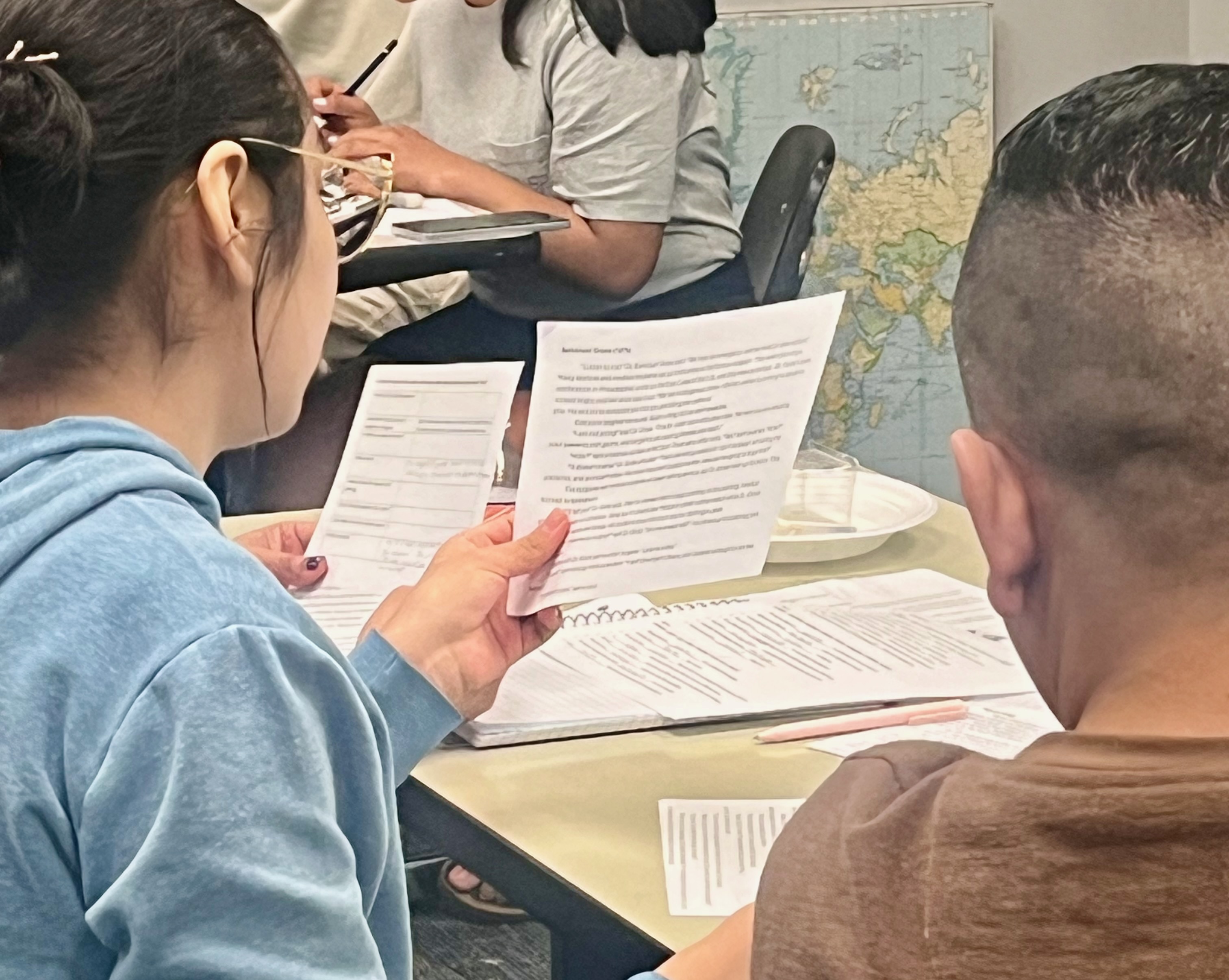
Once the historical context was set, along with a sense of the prevailing attitudes toward infection, students were prepped for the texts. They did a quick preliminary vocabulary lesson and were put into groups. Each group was given a collection of short half page readings that followed various characters through key moments in Lister’s life. For example, Lister’s wife is shopping when she is accosted at the market by another surgeon who warns her that Lister is crazy to think “little animals” swim in our bodies. Queen Victoria tells her bewildered friend about having Lister use his carbolic acid method to disinfect the operating room before doing her surgery. Medical students challenge Lister to defend himself against the accusations of his peers. Gross calls on his colleagues to stop Lister’s ideas from taking root.
Students in each group were tasked with dividing up the readings and then sharing information in the creation of two products: a) a timeline of events, and b) a set of character profiles. Who was each person? What did they believe? What did they want? What decision did they have to make?
My goal was for the students to articulate (in English) how germ theory unfolded while at the same time getting to know the key figures. “Figure it out however you want,” I said with my fingers crossed behind my back. I did not want to confuse them with too many instructions. My hope was that they would work it out amongst themselves, helping one another understand and calling me over when needed.
And then I waited. Time passes slowly when groups work on their own, and that’s what happened. They read, they talked, they wrote, and then they looked at the texts again. I was a little worried about the personality dynamics in one group, but overall, the students seemed industrious and engaged.
I looked at my notes. I looked at the group. We completed the timeline together on the board, and they finished their character profiles. Then they started discussing their roles. As often happens, they were in a process that I didn’t want to interrupt. After cleaning the coffee maker and putting away the snacks and texting my colleague, I called for their attention. “It’s getting late, and I know you only have so much energy,” I said. What if we did the second part on Tuesday. Then you can think and prepare over the weekend, and we can do our performance when we are fresh.”
Relieved, the students said yes. They packed up and went home, several of them picking up the optional extra readings I set out.
Upon reflection, I think it was okay we postponed the performance. Their needing extra time with the texts was a good sign. As my former education professor, Janis Birdsall, used to say, it always takes longer when things are going well.
So I am going to end this post with a cliffhanger. What will happen when we actually implement process drama is still uncertain, but I have a feeling that if I just trust the students’ initiative and creativity, it’s going to be a good show.
… to be continued.
References
Bolton, G. (1984). Drama as education: An argument for placing drama at the centre of the curriculum. Longman.
Fitzharris, L. (2017). The butchering art: Joseph Lister’s quest to transform the grisly world of Victorian medicine. Farrar, Straus and Giroux.
Heathcote, D., & Bolton, G. (1995). Drama for learning: Dorothy Heathcote’s mantle of the expert approach to education. Heinemann.
Immordino-Yang, M. H. (2015). Emotions, learning, and the brain: Exploring the educational implications of affective neuroscience. W. W. Norton & Company.
O’Neill, C. (1995). Drama worlds: A framework for process drama. Heinemann.
Savage, A. (2019). The drama book: Lesson plans, activities, and scripts for English-language learners. Alphabet Publishing.


Leave a comment