
After students have studied a set of vocabulary, they are often left with a long list of words which can appear quite lonely. Many textbooks include these lists as a reference for students at the end of unit, but what if they could be used more actively in […]
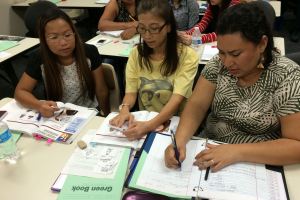
Students rely on models to help them communicate accurately and effectively. How often do you see a student’s thesis statement modeled after one in the textbook? Words are swapped out, but the pattern of the sentence essentially remains the same. Swapping is a useful learning strategy, and one […]
Making tests that push our students enough but not too far can feel like one of the biggest challenges for teachers. Tests that are too easy may lead to a false assessment of proficiency. Those that are too hard can be discouraging to students, and challenging for teachers to grade. What we want […]

For native speakers, a writing process that starts with a plan and ends with sentence-level editing makes sense. However, nonnative writers have different challenges, especially at the introductory level. Fortunately, process writing is not set in stone. We can adapt it to suit our students’ needs. The first […]

Below is a slideshow of one of the presentations we gave at Baltimore TESOL, “Thinking Outside the Paragraph,” where we outline three key principles that inform our teaching of academic writing at lower levels and helped formulate the pedagogy behind our new writing series, Trio Writing, by Oxford University Press. Beginning […]
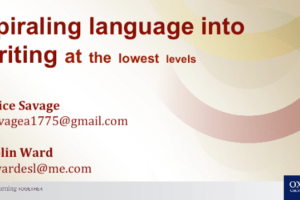
We had a wonderful time at Baltimore TESOL this year! Below is a copy of the presentation we gave about the Spiraling Lesson Plan, the pedagogy that forms the basis of our new writing series by Oxford University Press, Trio Writing.

We are looking forward to another wonderful conference in Baltimore next week, and quite excited it’s also celebrating TESOL’s 50th Anniversary. Alice and I will be giving a couple of presentations this year. Hope to see you @ the conference! #TESOL16 Thinking Outside the Paragraph Wednesday, April 6, […]

College writing is meant to be a meaningful experience, at least for the writer, and if it goes well, for the reader as well. At its best, a paper brings new knowledge into the world. But it often takes a bit of struggle to get beyond the obvious […]

Meeting the demands of writing with language learning is an uphill climb, so one nice thing we can do for second language writers is reduce their cognitive load. A sentence builder box does this by providing relevant vocabulary in a structure that is salient to a task. Students use […]

All good writers—no matter what they are writing about—share a secret, and that is the power of being specific. Anyone can circle around a topic with vague statements and abstract commentary, but where writing really gets interesting is when it tells the reader something she doesn’t already know. […]
 English Endeavors